
Puffer Tote Bag Quality Guide: 5 Manufacturing Details That Reduce Returns
A puffer tote bag may look simple, but small construction details can make a huge difference.
Many brands experience costly problems shortly after launching a new collection:
- Broken zippers
- Split handles
- Uneven quilting
- Fiber leakage
- Product returns
The good news?
Most of these issues are preventable.
At Kai Bags, we've manufactured bags for more than 20 years and helped brands, wholesalers, retailers, and private-label companies develop high-quality puffer tote bags for the US, Europe, and Australia.
In this guide, we'll show you the five construction details every buyer should check before placing an order.
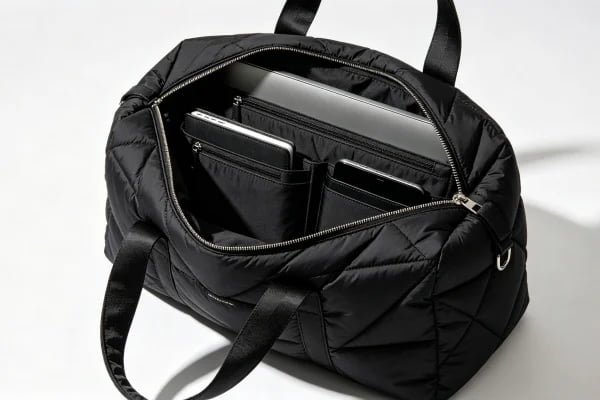
Quick Answer: What Makes a High-Quality Puffer Tote Bag?
If you're short on time, focus on these five specifications:
✓ 7-8 stitches per inch
✓ Reinforced Box-X handle construction
✓ No.5 anti-snag zippers
✓ 210D high-density lining
✓ Fiber migration protection
These details may seem small, but they can significantly reduce product returns and improve customer satisfaction.
Why Construction Quality Matters
Puffer tote bags are different from regular tote bags.
Unlike traditional bags, puffer totes are constantly under pressure because of their internal padding.
Everyday items such as:
- Laptops
- Water bottles
- Cosmetics
- Gym clothing
- Travel accessories
all place additional stress on the bag.
If the internal structure isn't properly engineered, failures quickly appear.
Common problems include:
- Broken handles
- Stuck zippers
- Deformed shapes
- Escaping fibers
This is why construction quality matters just as much as appearance.
5 Construction Details Every Buyer Should Check
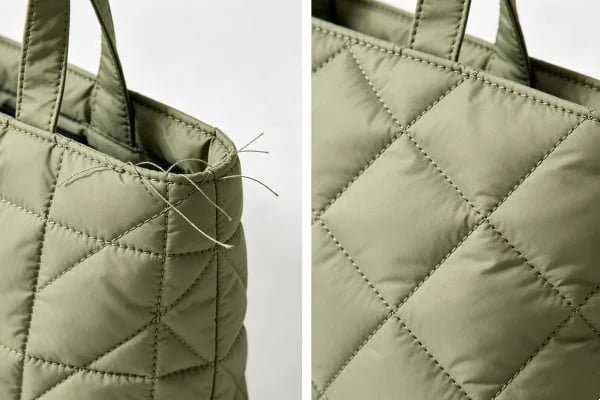
1. Stitch Density
Stitching is the foundation of durability.
Many low-cost factories use:
5-6 stitches per inch.
This creates larger needle holes and weaker seams.
We recommend:
7-8 stitches per inch.
Benefits include:
- Stronger seams
- Better shape retention
- Reduced fiber leakage
- Longer product lifespan
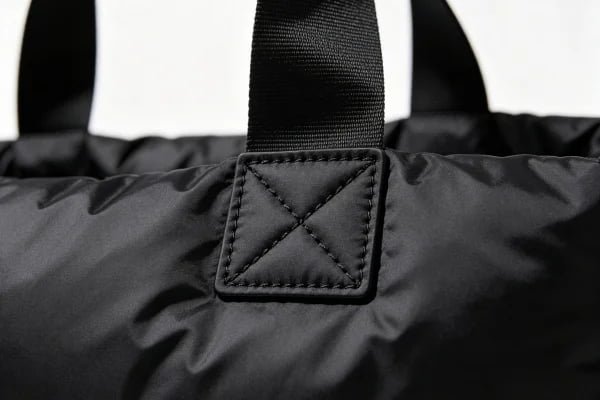
2. Handle Reinforcement
The handle connection is the highest stress point.
Without reinforcement, handles may tear after repeated use.
Professional manufacturers should use:
Box-X Stitch Construction
This pattern distributes weight evenly across the bag body.
A properly reinforced handle should withstand:
15kg (33 lbs) pull-force testing.
Always ask suppliers:
"How do you reinforce the handle attachment area?"
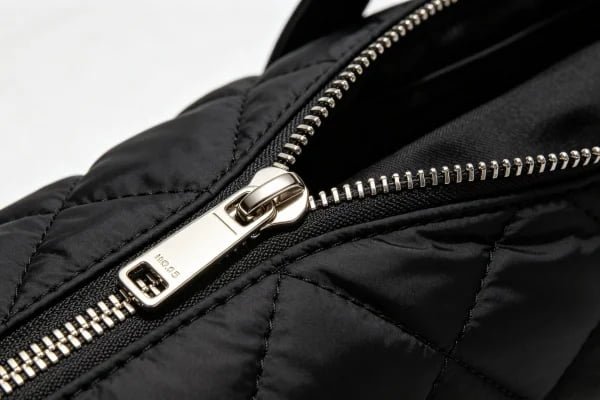
3. Zipper Quality
A zipper failure often leads to immediate customer complaints.
For puffer bags, we recommend:
Premium Option
No.5 zinc alloy zipper
Best for:
- Fashion brands
- Premium collections
Utility Option
No.5 reverse coil zipper
Best for:
- Travel bags
- Everyday use
- Water-resistant products
4. Anti-Snag Protection
Puffer fabrics can easily get caught inside zipper tracks.
This creates:
- Fabric damage
- Customer frustration
- Product returns
Professional factories solve this by adding an internal zipper guard.
This creates a safe clearance space between the zipper and the fabric.
5. High-Density Lining
The lining is often overlooked.
However, it directly impacts long-term performance.
Low-cost factories often use:
170T polyester lining.
This may cause:
- Fiber leakage
- Dusty appearance
- Reduced product quality
We recommend:
210D polyester taffeta or ripstop nylon.
Benefits:
- Cleaner interior
- Better durability
- Premium appearance
Optional Features That Modern Buyers Love
Today's consumers expect more functionality.
Popular upgrades include:
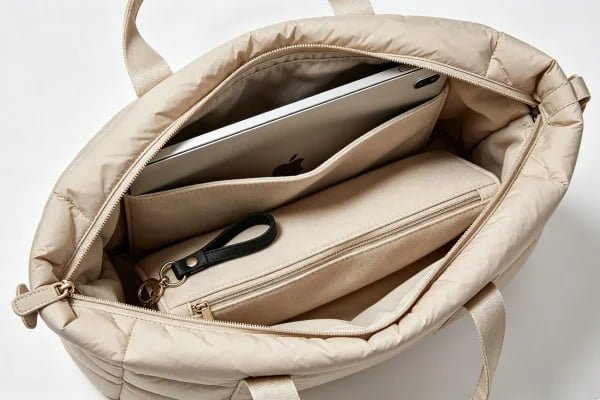
Laptop Sleeves
Protect electronic devices.
Wet & Dry Compartments
Separate wet items from valuables.
Key Leashes
Quick access to keys.
Luggage Sleeves
Ideal for travel collections.
These features help increase perceived value.
3 Costly Mistakes Buyers Should Avoid
Mistake #1: Choosing Cheap Zippers
Result:
- Stuck zippers
- Negative reviews
- Returns
Mistake #2: Ignoring Handle Reinforcement
Result:
- Broken straps
- Customer complaints
Mistake #3: Choosing Thin Lining
Result:
- Fiber migration
- Cheap appearance
Remember:
The cheapest supplier often becomes the most expensive mistake.
Puffer Tote Bag Quality Checklist
Before placing an order, ask your supplier these questions:
✓ What stitch density do you use?
✓ How are the handles reinforced?
✓ Which zipper brands do you recommend?
✓ What lining materials do you use?
✓ How do you prevent fiber leakage?
✓ What quality inspections do you perform?
✓ Can you provide factory audit reports?
✓ Can you provide production videos?
A trustworthy supplier should answer every question clearly.
How We Help Buyers Reduce Shipping Costs
Puffer bags occupy more volume than standard tote bags.
This can increase freight costs.
At Kai Bags, we use industrial vacuum compression packing.
Benefits:
- Reduce cargo volume by up to 40%
- Increase container utilization
- Lower shipping costs
- Improve warehouse efficiency
This is especially useful for Amazon FBA sellers and large retail programs.
Frequently Asked Questions
What zipper size is best for puffer tote bags?
No.5 zippers provide the best balance between durability and smooth operation.
Why do some puffer bags leak filling?
Poor stitching and low-density lining are usually the main causes.
How much weight should a puffer tote bag hold?
A properly reinforced bag should withstand at least 15kg (33 lbs).
How can I reduce product returns?
Focus on zipper quality, handle reinforcement, lining density, and quality inspections.
Can puffer bags be compressed for shipping?
Yes. Vacuum packing can reduce shipping volume by up to 40%.
Can I fully customize the bag?
Yes. We support OEM and ODM projects, including logos, hardware, compartments, and packaging.
Can recycled materials be used?
Yes. Recycled polyester and recycled nylon are available.
Why Buyers Work With Kai Bags
We don't just manufacture bags.
We help buyers reduce risks before production even begins.
Factory Capability Snapshot
| Item | Details |
|---|---|
| Manufacturing Experience | 20+ Years |
| Monthly Capacity | 100,000 Bags |
| Production Equipment | 40+ Machines |
| OEM & ODM Service | Available |
| Sample Lead Time | 5-7 Days |
| Production Lead Time | 25-35 Days |
| Factory Audits | BSCI & SMETA |
| Main Markets | USA, Europe, Australia |
Our customers include:
- Fashion brands
- Amazon sellers
- Retail chains
- Promotional companies
- Corporate gifting distributors
Ready to Build a Better Puffer Tote Bag Collection?
A beautiful bag attracts customers.
A well-engineered bag keeps them coming back.
Whether you're launching a private-label collection, expanding your retail assortment, or developing a promotional program, our team can help reduce risks before production begins.
Contact Kai Bags Today For:
✓ Construction Recommendations
✓ Material Suggestions
✓ Hardware Options
✓ Sample Development
✓ Factory Direct Pricing
✓ Shipping Optimization Advice
✓ Production Timeline Planning
Let's build a puffer tote bag collection that customers will keep using—not returning.
[…] → Puffer Tote Bag Quality Guide […]
[…] → Puffer Tote Bag Quality Guide […]
[…] → Puffer Tote Bag Quality Guide […]
[…] → Puffer Tote Bag Quality Guide […]
[…] → Puffer Tote Bag Quality Guide […]
[…] → Puffer Tote Bag Quality Guide […]