
Best Backpack Size Guide (2026): Capacity, Dimensions & OEM Buying Guide
Hero
Choosing the right backpack size is about much more than liters. Capacity, dimensions, weight distribution, airline restrictions, laptop compatibility, and end-user scenarios all determine whether a backpack succeeds in the market.
For brands, wholesalers, retailers, and importers, selecting the wrong size can lead to higher shipping costs, lower customer satisfaction, and unnecessary inventory risks.
As a backpack manufacturer with over 20 years of OEM & ODM experience, we've helped hundreds of global brands develop backpack collections tailored to travel, business, education, sports, and outdoor markets.
In this guide, you'll learn how to compare backpack capacities, understand standard dimensions, choose the right size for different applications, and make smarter sourcing decisions for your next custom backpack project.
Quick Answers
The best backpack size depends on its intended use. A 20L backpack is ideal for daily commuting and office use, a 30L backpack offers the best balance for weekend trips and business travel, while a 40L backpack is suitable for extended travel and most airline carry-on requirements. When sourcing custom backpacks, buyers should evaluate not only capacity but also external dimensions, laptop compartment size, ergonomic design, and shipping efficiency to maximize customer satisfaction and profitability.
Key Takeaways
- 20L backpacks are best for commuting, students, and everyday carry.
- 30L backpacks are the most versatile option for travel, work, and weekend use.
- 40L backpacks are preferred for airline carry-on travel and outdoor adventures.
- Backpack capacity (liters) does not always equal usable storage space.
- OEM buyers should consider dimensions, weight, laptop compatibility, and shipping costs—not just capacity.
Backpack Size Comparison Table
| Capacity | Typical Dimensions (H × W × D) | Weight | Best For | Fits Laptop | Airline Carry-On |
|---|---|---|---|---|---|
| 15L | 40 × 25 × 12 cm | 0.4–0.7 kg | Daily essentials | Up to 13" | Yes |
| 20L | 45 × 28 × 15 cm | 0.5–0.8 kg | Commuting, school, EDC | Up to 15.6" | Yes |
| 25L | 48 × 30 × 18 cm | 0.6–0.9 kg | Office, weekend trips | Up to 15.6" | Yes |
| 30L | 50 × 32 × 20 cm | 0.8–1.2 kg | Business travel, short trips | Up to 17" | Yes |
| 35L | 53 × 33 × 22 cm | 1.0–1.3 kg | Multi-day travel | Up to 17" | Usually |
| 40L | 55 × 35 × 23 cm | 1.1–1.5 kg | Carry-on travel, outdoor | Up to 17" | Most airlines |
| 45L+ | 60 × 38 × 25 cm | 1.3 kg+ | Hiking & expedition | Up to 17" | Usually No |
Why Backpack Size Matters
Backpack size is one of the most important purchasing factors for both consumers and B2B buyers. It directly affects product usability, transportation costs, manufacturing costs, and customer satisfaction.
Choosing the right capacity ensures the backpack matches its intended application while maintaining comfort and efficiency.
For manufacturers, backpack size also influences:
- Material consumption
- Production cost
- Hardware selection
- Carton loading quantity
- Shipping cost
- Warehouse efficiency
A poorly sized backpack can increase freight costs, reduce customer satisfaction, and lower repeat purchase rates.
Buying Guide
Step 1: Understand Backpack Capacity
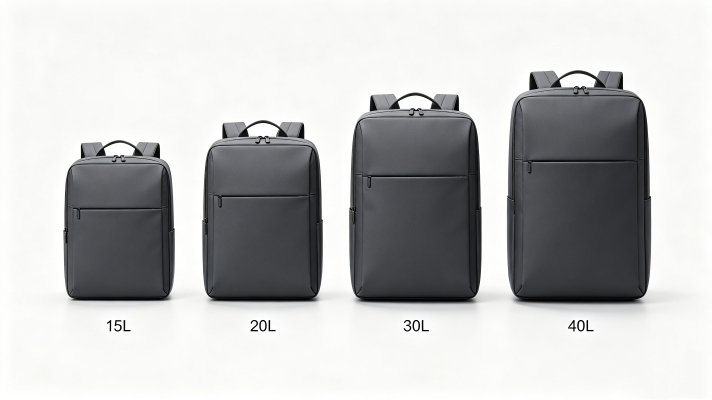
Backpack capacity is measured in liters (L) and represents the total internal storage volume rather than the exterior dimensions.
For example:
| Capacity | Typical Usage |
|---|---|
| 15–20L | Everyday carry, commuting |
| 20–25L | School, office, students |
| 25–30L | Business travel |
| 30–40L | Weekend travel |
| 40L+ | Outdoor adventures, extended trips |
Step 2: Match Size to User Scenarios
Successful backpack brands don't simply choose a popular size—they select capacities based on the target customer's lifestyle.
Daily Commuters
Recommended Capacity:
- 15L–20L
Ideal for:
- Laptop
- Charger
- Water bottle
- Notebook
- Lunch box
Students
Recommended Capacity:
- 20L–25L
Ideal for:
- Textbooks
- Laptop
- Stationery
- Sportswear
Business Travelers
Recommended Capacity:
- 25L–30L
Ideal for:
- 15–17 inch laptop
- Documents
- Clothing for 1–2 days
- Electronics
Frequent Flyers
Recommended Capacity:
- 30L–40L
Ideal for:
- Carry-on luggage
- Packing cubes
- Travel accessories
- Toiletries
- Shoes
Outdoor Users
Recommended Capacity:
- 35L–50L
Ideal for:
- Hiking gear
- Camping equipment
- Extra clothing
- Hydration systems
Step 3: Consider External Dimensions
Many buyers focus only on capacity, but dimensions are equally important.
External dimensions determine:
- Airline carry-on compliance
- Shipping carton efficiency
- Retail shelf display
- Ergonomics
- Weight distribution
For OEM projects, dimensions should always be finalized before material sourcing and pattern development.
Tip For Buyer
When developing a new backpack collection, avoid launching too many capacities at once.
Our recommendation is to start with three core sizes:
- 20L — Everyday & School
- 30L — Business & Travel
- 40L — Carry-On & Outdoor
This approach simplifies production, reduces inventory complexity, and covers the majority of global market demand.
Technical Deep Dive
Selecting the right backpack size involves much more than choosing a liter capacity. Professional buyers should evaluate capacity, external dimensions, compartment layout, ergonomics, weight distribution, airline compliance, and target user scenarios before finalizing a design.
At our factory, backpack development always starts with the customer's target market, not with the fabric or logo. This approach helps brands avoid overengineering products while maximizing customer satisfaction.
20L Backpack: Best for Everyday Carry
The 20L backpack has become one of the most popular capacities worldwide thanks to its versatility. It offers enough space for everyday essentials while remaining lightweight and comfortable.
Typical Dimensions
| Specification | Measurement |
|---|---|
| Capacity | 20 Liters |
| Height | 43–46 cm (17–18 in) |
| Width | 27–30 cm (10.5–12 in) |
| Depth | 14–17 cm (5.5–6.7 in) |
| Weight | 0.5–0.8 kg |
What Fits Inside?
A typical 20L backpack can carry:
- 15.6" laptop
- Tablet
- Notebook
- Water bottle
- Lunch box
- Power bank
- Charger
- Small accessories
Advantages
- Lightweight
- Lower shipping costs
- Comfortable for long periods
- Lower production cost
- Suitable for almost every customer group
Limitations
- Limited clothing storage
- Not ideal for overnight travel
- Less space for camera or sports equipment
Factory Insight
Our production data shows that 20L backpacks account for nearly 35% of OEM orders for business brands and educational customers.
Most successful Amazon and Shopify brands launch their first backpack collection with a 20L daily backpack, as it appeals to the widest range of users and keeps shipping costs low.
30L Backpack: The Most Versatile Choice
If customers could only own one backpack, a 30L backpack would be the best all-around option.
It provides significantly more storage than a 20L backpack while remaining compact enough for daily use and airline travel.
Typical Dimensions
| Specification | Measurement |
|---|---|
| Capacity | 30 Liters |
| Height | 48–52 cm (19–20.5 in) |
| Width | 30–33 cm (12–13 in) |
| Depth | 18–22 cm (7–8.7 in) |
| Weight | 0.8–1.2 kg |
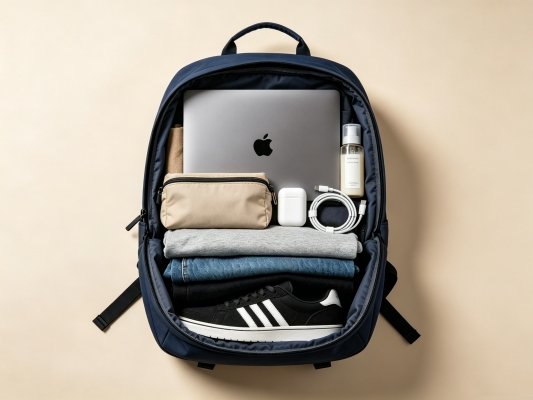
What Fits Inside?
- 17" laptop
- Tablet
- 2–3 days of clothing
- Camera
- Shoes
- Toiletries
- Chargers
- Documents
Advantages
- Excellent storage capacity
- Suitable for both work and travel
- High customer satisfaction
- Strong retail demand
Limitations
- Slightly heavier
- Higher material consumption
- Increased freight costs
OEM Recommendation
For brands targeting business travelers, remote workers, and digital nomads, a 30L backpack is often the safest investment.
It combines:
- Everyday practicality
- Travel functionality
- Premium perceived value
- Strong online sales performance
Many of our OEM clients select 30L as their flagship model because it appeals to both B2B buyers and end consumers.
40L Backpack: The Preferred Carry-On Size
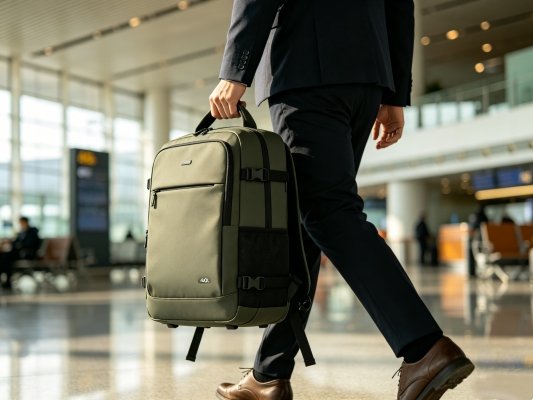
The 40L backpack is designed for travelers who need maximum storage while staying within most airline carry-on restrictions.
It has become increasingly popular among:
- Frequent flyers
- Adventure travelers
- Outdoor enthusiasts
- Backpacking brands
Typical Dimensions
| Specification | Measurement |
|---|---|
| Capacity | 40 Liters |
| Height | 53–56 cm (21–22 in) |
| Width | 33–36 cm (13–14 in) |
| Depth | 22–24 cm (8.7–9.5 in) |
| Weight | 1.0–1.5 kg |
What Fits Inside?
- 4–5 days of clothing
- 17" laptop
- Packing cubes
- Travel accessories
- Toiletries
- Shoes
- Camera equipment
Advantages
- Large storage capacity
- Replaces small rolling luggage
- Popular among travel brands
Limitations
- Higher production cost
- More fabric consumption
- May exceed carry-on limits if overpacked
Carry-On Backpack Size Guide
One of the most common questions from buyers is:
What size backpack qualifies as a carry-on?
Although airline regulations vary, most international carriers accept carry-on backpacks within the following dimensions:
| Airline Standard | Maximum Dimensions |
|---|---|
| Typical Carry-On | 55 × 35 × 23 cm |
| Personal Item | 40 × 30 × 15 cm |
A well-designed 40L backpack can typically comply with these limits when not overfilled.
Factory Recommendation
When developing travel backpacks for global markets, we recommend keeping external dimensions below 55 × 35 × 23 cm to maximize airline compatibility.
Laptop Backpack Dimensions
Laptop compatibility is another critical purchasing factor.
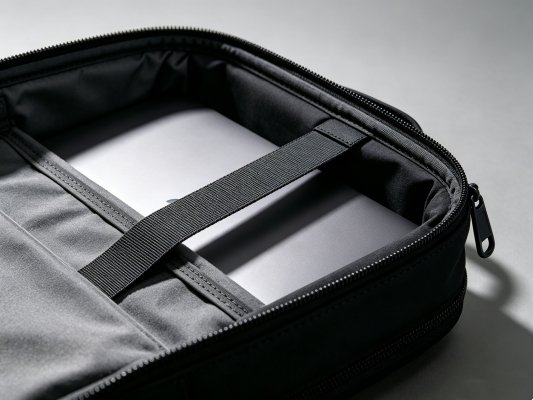
Different laptop sizes require different compartment dimensions.
| Laptop Size | Recommended Compartment Size |
|---|---|
| 13 inch | 33 × 24 cm |
| 14 inch | 35 × 25 cm |
| 15.6 inch | 39 × 28 cm |
| 16 inch | 40 × 29 cm |
| 17 inch | 43 × 31 cm |
Design Recommendations
A professional laptop compartment should include:
- Foam padding
- Velvet lining
- Raised bottom protection
- Elastic securing strap
- Waterproof zipper
These features significantly improve product value and customer satisfaction.
Factory Insight: Choosing the Right Size Portfolio
One common mistake we see is brands launching too many backpack sizes in their first collection.
Instead, we recommend starting with three core capacities:
| Capacity | Target Customer |
|---|---|
| 20L | Students, commuters, office workers |
| 30L | Business travelers, remote workers |
| 40L | Travel and outdoor customers |
This streamlined product strategy:
- Reduces development costs
- Simplifies inventory management
- Improves manufacturing efficiency
- Covers over 80% of mainstream backpack demand
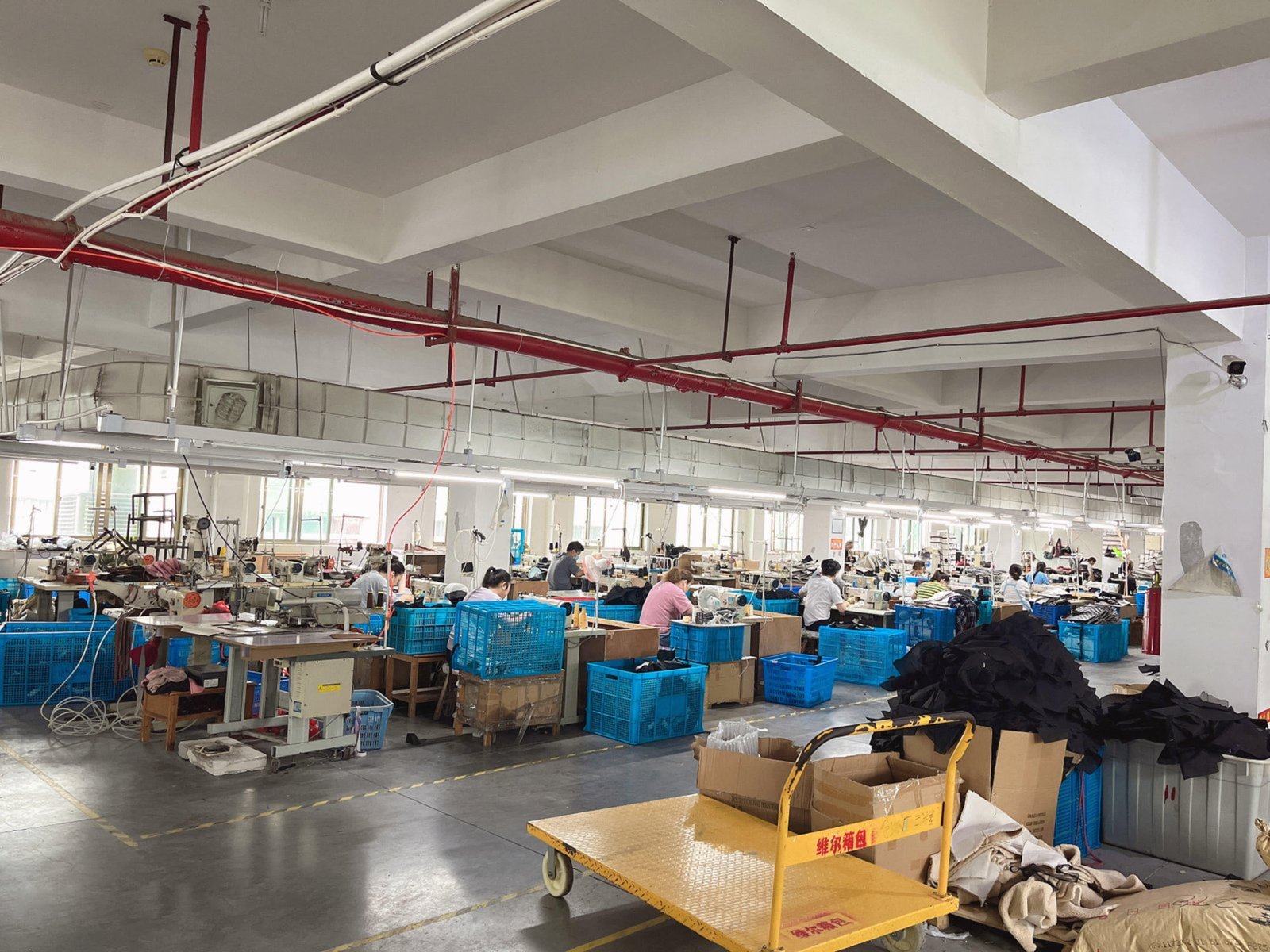
OEM Recommendations for Different Markets
Selecting the right backpack size is not only a design decision—it is a market positioning decision. Different regions, sales channels, and customer groups have very different expectations for capacity and dimensions.
US Market Recommendation
The US market prefers larger, more versatile backpacks with strong storage capacity.
| Segment | Recommended Size |
|---|---|
| Amazon / eCommerce | 20L–30L |
| Business / Travel | 30L–40L |
| Outdoor / Tactical | 35L–50L |
Insight
US consumers value:
- Multi-function design
- Large storage capacity
- Laptop compatibility (15.6–17 inch)
- Travel readiness
👉 For US-focused brands, 30L is the safest core SKU.
European Market Recommendation
European buyers prefer compact, lightweight, and urban-friendly designs.
| Segment | Recommended Size |
|---|---|
| Urban commuting | 15L–20L |
| Business use | 20L–30L |
| Travel | 30L–35L |
Insight
EU customers prioritize:
- Lightweight design
- Sustainability (RPET materials)
- Compact dimensions for public transport
👉 20L is often the best-selling size in Europe.
Amazon Seller Strategy
For Amazon FBA brands, size selection directly impacts conversion rate and reviews.
Best Performing Sizes:
- 20L → Entry product (high conversion)
- 30L → Best seller (main revenue driver)
- 40L → Premium upsell product
Factory Insight
Successful Amazon backpack brands usually:
- Launch with 20L + 30L combo
- Use 40L as premium listing for upsell
- Optimize listings based on size comparison charts
Common Buyer Mistakes (Critical for OEM Success)
1. Confusing Capacity with Usable Space
Two 30L backpacks may have completely different internal layouts.
👉 Always check:
- Compartment structure
- Pocket design
- Expansion capability
2. Ignoring Airline Size Rules
Many travel backpacks fail because they exceed:
- 55 × 35 × 23 cm carry-on limit
👉 Always test real packed dimensions, not empty size.
3. Over-Engineering First Collection
New brands often launch:
- 10+ sizes
- Too many SKUs
- High inventory risk
👉 Best strategy: Start with 3 sizes only:
- 20L
- 30L
- 40L
4. Laptop Size Mismatch
A common issue is:
- 15.6" laptop listed
- But actual compartment only fits 14"
👉 Always confirm:
- Internal padded compartment size
- Not external dimensions
5. Ignoring Weight Distribution
Poorly designed large backpacks (40L) often:
- Shift weight backward
- Cause shoulder fatigue
- Reduce customer satisfaction
Related Guides (Internal Linking Strategy)
To strengthen your Backpack Knowledge Center, this page should internally link to:
- 👉 Best Backpack Materials Guide (2026)
- 👉 [Best Backpack Size Guide (2026)] (https://kaibags.com/backpack-size-guide-2026-capacity-dimensions-oem-buying-guide/)
- 👉 Best Logo Methods for Backpacks (2026)
- 👉 Backpack Manufacturing Process (OEM Guide)
- 👉 Backpack MOQ Guide
FAQ
What is the best backpack size for daily use?
A 20L backpack is ideal for daily commuting, school, and office use because it balances capacity and portability.
Is a 30L backpack big enough for travel?
Yes, a 30L backpack is suitable for 2–3 day trips and is widely used for business travel and weekend travel.
Is a 40L backpack carry-on size?
In most cases, yes. A 40L backpack usually fits airline carry-on limits if packed properly and designed within 55 × 35 × 23 cm dimensions.
What size backpack fits a 17-inch laptop?
A backpack with at least 30L capacity is recommended, with an internal compartment of approximately 43 × 31 cm.
What does backpack capacity mean?
Backpack capacity refers to internal volume measured in liters (L), not external dimensions. It indicates how much the backpack can hold.
Which is better, 20L or 30L backpack?
20L is better for daily use, while 30L is better for travel and multi-purpose use. The choice depends on lifestyle and usage scenario.
What is the most popular backpack size?
Globally, 20L and 30L are the most popular sizes because they cover both daily and travel use cases.
CTA (Conversion Section)
Start Your Custom Backpack Project
We are a 20-year OEM & ODM backpack manufacturer helping global brands, importers, and Amazon sellers develop high-performance backpack collections.
What We Offer:
- Custom backpack sizing (20L / 30L / 40L / more)
- OEM & ODM product development
- Material & fabric sourcing support
- Logo customization (embroidery, print, patch)
- Low MOQ production support
- Fast sampling (5–7 days)
👉 Get your free backpack catalog & quotation within 24 hours
📩 Email: emma@keyuanbag.com 💬 WhatsApp: +86 13867943946



[…] Best Backpack Size Guide (2026) […]
[…] Best Backpack Size Guide (2026) […]